Prime Cuts #5: To Live and Die in L.A. & Weekend
Screenshot
William Friedkin was an extraordinary film director. The French Connection (1971) is one of my favorite movies and Sorcerer (1977) and To Live and Die in L.A. (1985) are also exceptional. Early on, Friedkin suggested a deep admiration for the French New Wave with a bit of French graffiti, “La Dernier Cri” (which translates to “The Latest Trend” in English), a non sequitur written on the side of a rundown city building during a scene in The French Connection. This enthusiasm pushed him to re-envision Henri-Georges Clouzot’s absolute classic, The Wages of Fear, as the fever dream Sorcerer; this task, perhaps impossible, made more so with the location shooting Friedkin used in the Dominican Republic. What I aim to drive at here is a conjecture on my part- what motivated Friedkin’s outcome of the brilliant car chase from To Live and Die in L.A.?
While Peter Yates set the bar for cinematic car chases extremely high in 1968 with Bullitt, Friedkin was able to respond in full with his own iconic chase in The French Connection (the entire film can be read as one long, existential pursuit as soon as Gene Hackman’s character, Popeye Doyle, is introduced toward the beginning of the movie, working as an undercover police detective disguised as Santa Claus). The majority of this sequence takes place as Doyle pursues an elevated M train running above Brooklyn. Interestingly, the train is rarely in Doyle’s sight while he follows it, racing forward, searching, seeking, looking.
Friedkin is a master at layering tension. He illustrates that during this segment while, in parallel, there is also a chase taking place on the train itself; a French killer pursued by a cop and then a security guard until there is nowhere else left to run. This car chasing a train can be read as an updated Western trope, men on horseback racing after a wagon or train, one that goes back at least as far as John Ford’s Stagecoach from 1939. The exceptional car chase from The French Connection set up a problem for Friedkin when he created the film, To Live and Die in L.A. 14 years later- how can you outdo what can’t be outdone? He tried it with Clouzot’s The Wages of Fear, now why not himself?
The car chase sequence from To Live and Die in L.A. has equivalencies to that of The French Connection. Like Doyle, the aptly named Richard Chance (played by William Peterson) works undercover (though in this case for the U.S. Secret Service, not as a police detective); he has questionable ethics and a partner like Doyle’s who tries to hold the moral compass of their investigation in place; there is use of crane shots to move action at ground level to above ground; Chance also races to catch up to a train. But in To Live and Die in L.A., Friedkin turns the conventional motivation for a chase scene on its head. It is not Chance that is in pursuit, he and his partner have been targeted as criminals because they have accidentally fallen into a stakeout they must flee. Friedkin increases the tension when, after giving the impression that Chance and his partner have escaped capture, he begins a second, more intensified, hunt against them. This begins when a gunshot goes through the rear window of Chance’s car. His partner looks through the hole in the shattered glass directly at the viewer, “Sons of Bitches!”, and the pursuit begins anew. This time things go from bad to worse, with not just one car following them but many (in a sly foreshadowing, Chance is forced to drive directly toward and around two of them). Then, in a lucid moment of pure insanity, while his partner panics in the backseat, Chance makes a radical decision.
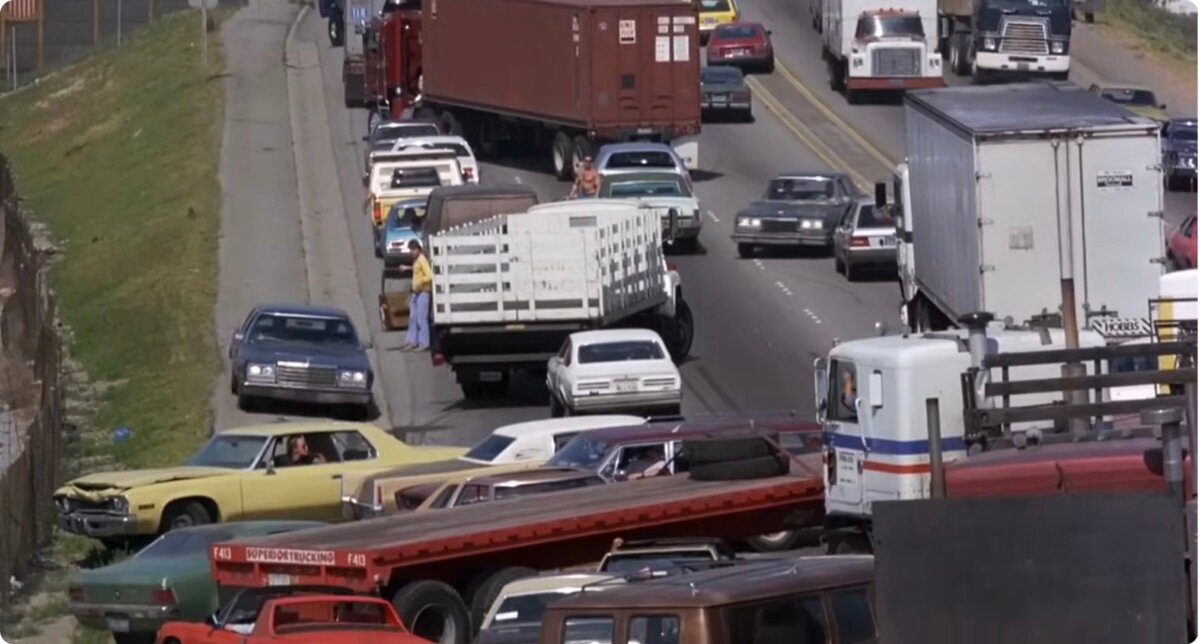
Completely surrounded on the highway with nowhere to go, Chance sees “Wrong Way” and “Do Not Enter” signs in front of an offramp. After a moment’s hesitation, he disregards them and turns directly into the oncoming traffic. Friedkin presents these street signs more than once during the scene. As mentioned earlier, as a student of the New Wave movement in cinema, it’s hard not to see his use of the signs as a reference to Jean-Luc Godard’s repeated use of them throughout the first part of his career. It’s especially difficult not to feel that this whole segment is a hidden homage to Godard when considering the end result of this action sequence; one that makes the chaos of the chase in The French Connection look sedate in comparison. After minutes of driving through advancing traffic, Chance is able to avoid colliding with a jackknifing truck by crossing the median into cars headed the right direction, leaving a pileup of autos behind him as he and his partner escape.
I cannot read this sea of cars except as a reference to the famous travelling shot of a traffic jam in Godard’s film Weekend (1968), a movie that defined a clear division in his career. It concluded with a title card that stated “The End of Cinema”. It would be the last narrative film Godard made before starting work on a radical cinema which was more directly focused on experimentation and politics, with collaborations like his Sonimage partnership with Anne-Marie Miéville, and his association with Jean-Pierre Gorin in the Dziga Vertov Group. It would not be until 1980 when Godard made Every Man for Himself (which he called his “second first film”) that he returned to more mainstream considerations (though clearly on his own creative terms).
Both To Live and Die in L.A. and Weekend are filled with brutality and spectacle in their indictments of a capitalist world gone mad. Friedkin escalates the corruption within the system of law from the city level in The French Connection to the federal level in To Live and Die in L.A., the depth of this corruption underscored when Chance’s partner takes over his dead partner’s role in “the system” at the end of the film. In both films the central characters try to escape the law and the rules of society, all using violence to do so. The two films explore and satirize capitalist greed and privilege each in their own ways, with To Live and Die in L.A. taking the American “right to the pursuit of happiness” to its extreme and criminal outcome.
To Live and Die in L.A. car chase:
Weekend original US trailer: